


A customer calls a business, gets no answer and moves on to a competitor. For the company that missed the call, the lost sale may go unnoticed. For startups developing voice AI, that moment represents a market opportunity — one that depends on more than making machines sound like people.
A new report from AI answering service Upfirst suggests that businesses are already losing customers because they cannot keep up with incoming calls. But while automated receptionists could help close that gap, consumers have expectations about how the technology should behave.
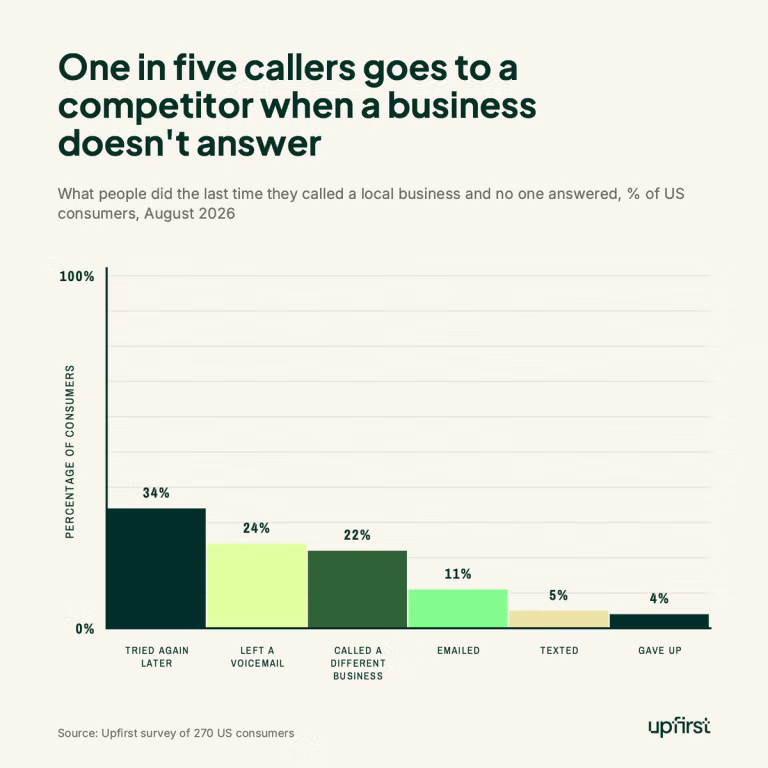
According to The State of Voice AI for Small Businesses 2026, 78% of surveyed US consumers said they had hired or purchased from a competitor because a business failed to answer or return their call. At the same time, 80% said they would want an AI receptionist to identify itself as artificial intelligence at the beginning of a conversation.
The findings come from surveys of 270 US consumers and 262 small and midsize business owners and managers, combined with an analysis of 677,562 calls handled for 2,967 US businesses between January 2025 and August 2026.
For startups entering the voice AI market, the figures point to a commercial problem that is easy to understand: businesses need to respond to more customers without necessarily hiring more staff.
A market built around operational gaps
The opportunity is particularly visible among businesses that have grown beyond what their owners can manage alone but cannot justify a dedicated receptionist.
Upfirst found that 91% of businesses with 10 to 49 employees missed at least one potential-customer call in a typical week. Among this group, 76% missed four or more calls, while 79% said they had already lost a customer because of an unanswered call.
Across all businesses surveyed, 58% reported missing at least one potential-customer call in a typical week.
These figures help explain why AI receptionists are attracting interest from companies that might otherwise rely on voicemail, callbacks or employees answering between other tasks. A voice agent can take messages, respond to routine questions, collect customer details and help schedule appointments when staff are unavailable.
The technology is also becoming less expensive to operate. Upfirst estimates that the cost of running a voice agent fell by roughly threefold to fivefold over the preceding year, as companies including OpenAI, Google and xAI introduced voice capabilities or reduced prices.
Lower costs could expand the addressable market for startups selling automated phone services. Businesses that previously considered a conventional answering service too expensive may now be able to automate at least part of their call handling.
However, the report suggests that adoption is driven by operational need rather than a general appetite for AI. Interest in AI receptionists rose from 32% among businesses that did not miss calls to 77% among those missing four or more calls per week.
That distinction matters for founders. The strongest sales proposition may not be replacing an existing employee, but recovering business that would otherwise be lost.
Voice AI adoption does not necessarily mean replacing employees
The data also challenges the assumption that companies are primarily adopting voice AI to reduce headcount.
Only 2.4% of solo operators surveyed reported using an AI receptionist, compared with 41.5% of businesses with at least 50 employees. Companies with larger teams are more likely to have enough call volume and operational complexity to benefit from automation.
Businesses already using AI receptionists were also more likely to have human staff covering calls outside business hours: 79%, compared with 48% among businesses that were not interested in the technology.
Meanwhile, 16.4% of calls in Upfirst’s dataset included an attempt to transfer the caller to a human.
These findings suggest that voice agents are often being used as an additional layer of customer-service capacity. They can handle routine interactions while passing more complicated requests to employees.
For startups, this creates room to differentiate through integration rather than automation alone. A product that connects to appointment systems, captures leads accurately and routes calls to the right person may deliver more value than one that simply conducts a convincing conversation.
It also raises an important product question: when should the AI stop trying to resolve an issue and bring in a human?
Customers care about transparency more than human-like voices
Upfirst’s 2026 report found that 80% of surveyed consumers want AI receptionists to identify themselves at the start of a call, while only 19% of respondents who were neutral or uncomfortable with the technology cited a natural-sounding voice as a factor affecting trust. Acceptance also depends on the task: 70% were comfortable with AI answering routine questions, but just 15% trusted it to handle complaints. The report also found that AI receptionists disclosing their identity were associated with roughly 20% fewer hang-ups in an earlier analysis, although this does not establish causation.
Voice AI could also help businesses serve customers across language barriers. In Upfirst’s call dataset, 13.4% of calls were in Spanish, and 29% of surveyed business owners said language barriers had cost them a customer. While these findings reflect Upfirst’s US-based users and do not represent every market, they point to opportunities for startups developing multilingual assistants. As voice technology becomes cheaper and more capable, the competitive advantage may come less from sounding human and more from earning trust, resolving routine requests reliably and knowing when to hand a conversation over to a person.